Key Collector Comics
- 4.6
- Rating
- 100.00K
- Installs
- Free
- Price

 Analysis by App-foxy
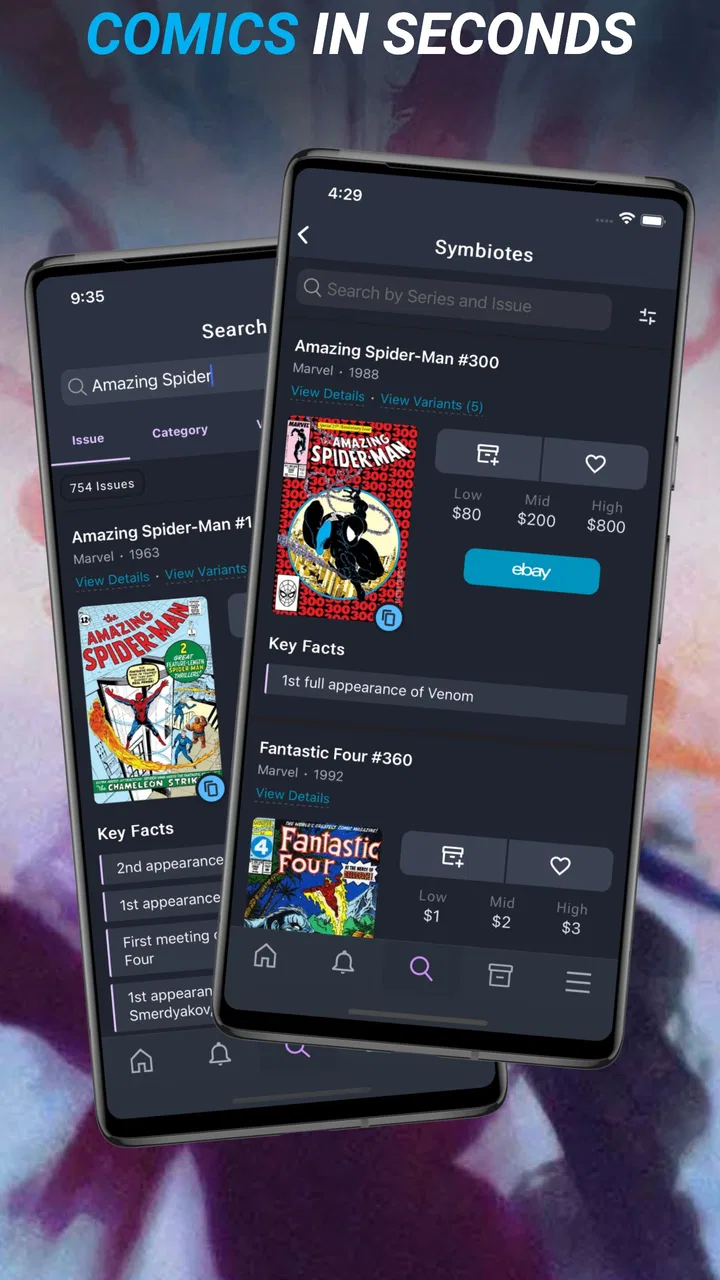
I opened Key Collector Comics with a familiar problem: a comic collection can grow faster than my memory of what I own, what I still want, and which issues deserve a closer look. A long box, a shelf, or a digital shopping list quickly becomes difficult to manage by eye. This app, developed by Key Collector Comics, is designed for that exact situation. It is a free comics app that combines collection management with a price-guide approach, rather than treating the hobby as simple reading or news browsing.
My first impression was that it makes more sense for an active collector than for someone who only reads an occasional graphic novel. The useful question here is not just “What comic is this?” but “How does this issue fit into my collection, my buying plans, and my understanding of its market interest?” That makes the app especially appealing when I am sorting a box, checking a possible purchase, or trying to turn an unorganized want list into something I can actually use.
From an Unsorted Collection to a More Useful Buying Plan
I start this section with the practical problem behind a growing collection: remembering what is already on the shelf before making another purchase. I’ll look at how I turn a first inventory pass into a useful buying plan, then move on to the routines that keep that plan manageable. A small, consistent cataloging habit can matter more than trying to record everything at once.
You May Also Like

 Blood Strike: 2.5 Anniversary
Blood Strike’s Loadouts Turn Every Drop Into a Tactical Gamble
A close look at Blood Strike’s custom loadouts: how fast access to signature weapons reshapes its battle royale rhythm, rewards preparation, and narrows the gap between fights.

 Pandora - Music & Podcasts
Pandora’s Music Is Easy to Start, but Harder to Recover
Pandora’s strength is its low-effort path from a seed to a station. Its weak spot is how much confidence it asks you to place in connection, setup, and quiet recovery.

 8 Ball Pool
 Is Built on Rivalries, Rematches, and Routine
A close look at the rivalries, rematches, shared routines, and unanswered safety questions that turn a quick pool match into a persistent mobile community.

 Samsung Music
’s Quiet Strength Is Playing What You Already Own
Its reach comes less from spectacle than from dependable access to a personal library. That simplicity is both the app’s strongest retention engine and its ceiling.

 AccuWeather: Weather Radar
AccuWeather Review: A Quick, Clear Forecast for Everyday Decisions
For everyday plans, the best forecast is the one you can understand quickly. AccuWeather makes rain timing, radar, and local conditions easy to act on, with a few trade-offs.

 Hill Climb Racing
Why Hill Climb Racing Still Turns Crashes Into One More Run
A tiny car, a bumpy hill and one more upgrade: Hill Climb Racing keeps resurfacing because its simple chaos makes every near-miss feel personal.
More From Our News Desk



The starting point: knowing what is already in the boxes
The best way to begin is with a clear purpose. If I simply browse without deciding whether I am cataloging owned comics, researching a character, or checking potential purchases, the experience can become a stream of interesting discoveries with no practical outcome. I found the app more valuable when I treated it as a working tool: identify an issue, record its place in my collection, compare it with related entries, and decide what action comes next.
That approach matters because comic collecting has several overlapping layers. A title may be important to me because of a story, a character, a creator, a first appearance, a variant, or its perceived market interest. A general notes app can record that I own something, but it does not naturally connect that note to a comics-focused reference system. A spreadsheet can be flexible, yet it asks me to build the structure myself. Key Collector Comics starts closer to the collector’s way of thinking.
The app is rated for Everyone, which makes it approachable for households where younger readers and adults share an interest in comics. Its category is Comics, but I would describe its role more precisely as a reference and organization companion for collectors. It is not a replacement for a digital comic reader, and that distinction is important before installing it. If my goal is to read issues on a phone, I would look elsewhere. If my goal is to understand and organize a physical collection, this is much closer to the right tool.
Building the first pass without making the collection harder
I would not start by trying to document every comic in one exhausting session. A better workflow is to begin with one shelf, one long box, or one character-focused group. That keeps the first pass manageable and gives the collection a consistent method. I can work from the cover, search for the issue, and then decide whether it belongs in my owned collection or on a list of comics I want to investigate later.
This separation is one of the most useful habits to establish early. A comic I own, a comic I have seen at a shop, and a comic I hope to buy are three different things. Mixing them creates false confidence. When I use the app as a bridge between physical books and future purchases, I am less likely to buy a duplicate simply because I forgot where an issue was stored.
A practical tip is to catalog in the same order that the comics are physically arranged. If my boxes are grouped by publisher, title, or era, I can follow that structure instead of jumping randomly between topics. The app can help me create a digital overview, but it cannot fix a storage system that has no logic. The strongest result comes from pairing the app with simple physical labels and a repeatable routine.
Searching is more useful when I already know what decision I need
When I search for an issue, I try to arrive with a question. Do I want to confirm whether I already have it? Am I comparing related issues? Am I checking whether a comic belongs on a shopping list? Am I trying to understand why collectors discuss it? This prevents the price-guide aspect from taking over the entire experience.
For example, imagine I am at a weekend comic shop with a short amount of time. I find a familiar character on a wall and recognize the title, but not the issue number. Instead of relying on memory, I can use the app to identify the entry and compare it with the notes I have built around my collection. The outcome is not necessarily an immediate purchase. Sometimes the most useful result is realizing that the issue is already in a box at home, or that the copy in front of me is not the version I intended to find.
This is where the app feels more focused than a general web search. Search engines often return a mixture of auction pages, forum discussions, advertisements, and incomplete listings. A comics-specific catalog gives me a more direct route to the issue itself. The trade-off is that I need to understand the difference between a catalog reference and a guaranteed selling price. A guide can support a decision, but condition, edition, completeness, demand, and the actual buyer or seller still matter.
Turning identification into a collection workflow
Once I identify an issue, I treat the entry as a handoff point. The app helps move information from the physical comic into a digital record, but the next step depends on my intention. For an owned comic, I want the record to support inventory. For a wanted comic, I want it to support shopping. For a comic I am researching, I want it to support a decision about whether it deserves space, money, or further reading.
This is also where I noticed a subtle limitation of collection apps in general: the quality of the result depends on the discipline of the person entering information. If I rush through a large pile and mark items carelessly, the collection may look complete while still containing mistakes. I prefer short sessions with a quick physical check after each group. That small pause is more valuable than trying to process a whole room in one sitting.
Another useful technique is to use the app before visiting a shop, not only while standing at a dealer’s table. I can review the gaps in my collection and decide which issues are priorities. That changes the shopping experience from wandering toward anything recognizable to looking for specific targets. It also makes it easier to set a personal spending limit, because I have already decided what matters most before the excitement of a crowded convention or store takes over.
Handoffs between the app, the shelf, and other people
Comic collecting is rarely a completely private activity. I may ask a friend to look for an issue, send someone a list of books to watch for, or hand a collection to another family member who needs to know what is already owned. Key Collector Comics is most useful in those moments when the app becomes a shared reference point rather than a private archive.
The handoff still needs care. A digital list is not automatically a condition report, a proof of ownership, or a complete insurance inventory. If I am asking someone else to buy a comic for me, I would include the issue identity and explain whether I care about a particular cover, edition, or physical condition. The app can reduce ambiguity around the comic itself, but my instructions still need to cover the real-world details.
I also would not use a price-guide figure as the only basis for a trade. A trade involves trust, timing, condition, and the preferences of both collectors. The app can help me recognize why an issue is being discussed and give me a stronger starting point for research. It should not replace looking closely at the book or having an honest conversation with the other person.
For a family collection, the handoff is simpler but still valuable. One person can catalog while another sorts the physical boxes. In that arrangement, I would establish a rule such as “nothing is moved until it has been recorded.” That prevents the digital inventory from drifting away from the shelves. The benefit is not flashy; it is the gradual creation of a shared memory for the collection.
What the finished result feels like
After a focused cataloging session, the result is more than a list of titles. I have a clearer picture of what I own, which gaps are genuine, and which discoveries deserve attention. That clarity is the app’s strongest practical benefit. It turns a vague feeling—“I think I have that issue somewhere”—into a more deliberate next step.
The price-guide element adds another layer. It gives me a way to think about comics not only as stories but also as collectible objects with different levels of interest. I appreciate that when I am sorting a mixed box and need to decide which books deserve closer inspection. It is particularly helpful for avoiding the opposite mistakes of the hobby: overlooking a comic because its cover looks ordinary, or assuming that every old comic is automatically valuable.
Still, I keep my expectations measured. A guide is useful for orientation, not certainty. The number shown in an app cannot tell me everything about a particular copy sitting in my hand. A damaged issue, a missing insert, a printing difference, or a condition detail can change the real-world conversation. My workflow is therefore: use the app to identify and prioritize, then inspect the physical comic and check current marketplace context before making a serious financial decision.
That distinction is one of the most important lessons for new collectors. The app can make me better organized and better informed, but it does not turn collecting into an automatic investment system. I would recommend it to someone who wants a practical reference companion, not to someone expecting a button that instantly reveals the exact cash value of every book.
Where the workflow becomes less comfortable
The first friction is the amount of work required from a large collection. No app can make thousands of physical comics identify themselves. If I own a few boxes, the process feels achievable. If I have a room full of long boxes, I need patience and a plan. The app helps with the structure, but cataloging remains a hands-on project.
The second issue is that collectors often care about details beyond a basic issue entry. Condition, signatures, restoration, personal purchase history, storage location, and sentimental value may all matter. A focused comics catalog can get me closer to the right record than a generic notes app, but I may still want a separate system for highly detailed collection management. This is a genuine trade-off: focus makes the app easier to approach, while specialist workflows may demand more customization.
The third friction is the temptation to browse endlessly. Comics reference tools can turn a short inventory task into an hour of reading about characters and issues I did not plan to investigate. I enjoy that side of the experience, but it can work against the original goal. My solution is to separate “cataloging time” from “research time.” During cataloging, I record and move on. Later, I return to the entries that genuinely deserve deeper attention.
There is also a financial boundary to keep in mind. The app is free to install, while in-app purchases range from a few dollars to amounts approaching forty dollars per item. That means I would start with the free experience and only consider an optional purchase after deciding whether the additional value fits my habits. Someone who only wants a basic personal list may not need to spend anything. A more committed collector may find paid elements worthwhile, but should judge them against how often the app is actually used.
Who should use it, and who should choose something else
I think Key Collector Comics is a strong fit for a collector who regularly buys physical comics, loses track of duplicates, or wants a focused way to connect a shelf inventory with a want list. It also suits someone who enjoys discovering the collecting significance of issues rather than treating every book as interchangeable. The app is easier to justify when it becomes part of a repeated routine: cataloging new purchases, preparing for a shop visit, and checking gaps after reorganizing storage.
It is less suitable for a reader whose main activity is consuming digital comics. It is also not my first choice for someone who needs a fully customized database with extensive fields for every physical detail. A spreadsheet or general inventory system may be better when the priority is flexible record design, household asset tracking, or highly specific storage metadata.
I would also caution a brand-new collector who is mainly chasing quick profits. The app can help identify issues that deserve attention, but collecting still requires judgment. Learning condition, editions, market timing, and responsible buying matters just as much as having a catalog. Used sensibly, the app supports that learning process. Used as a shortcut to guaranteed value, it can encourage overconfidence.
My recommendation after using the complete workflow
Key Collector Comics succeeds because it understands a real collector’s sequence: find a comic, identify it, decide whether it belongs in the collection, connect it to a want list, and use reference information to choose the next action. That chain is more useful than a simple title list, especially when I am moving between shelves, shops, conventions, and conversations with other collectors.
The app has been available since October 3, 2017, and its current version is 4.4.6. With over one hundred thousand installs and an average rating of 4.5 from around five and a half thousand ratings, it has clearly found an audience among people who want a dedicated comics companion. Those figures do not change my personal test of it, but they do make the app feel established enough to take seriously rather than like an abandoned experiment.
My final view is positive, with a clear condition: use it as the organizing center of a thoughtful collecting routine, not as an automatic valuation machine. I like the way it gives a scattered collection a direction, helps prevent avoidable duplicate purchases, and makes research more relevant to the books actually in front of me. I would install it for a physical comic collection, begin with a small section, and expand only after my cataloging habits were consistent. The best outcome is not knowing a number; it is making a better collecting decision.
FAQs for Key Collector Comics
01What is Key Collector Comics and how does it work?
Key Collector Comics is an app designed for comic book enthusiasts to help identify, manage, and value their collections. It provides users with a comprehensive database of key issues, first appearances, and valuable comics. The app offers tools for tracking your collection, finding undervalued comics, and staying updated with market trends.
02Is Key Collector Comics available for both Android and iOS?
Yes, Key Collector Comics is available for download on both Android and iOS platforms. Users can easily find the app on the Google Play Store for Android devices and the Apple App Store for iOS devices. The app is regularly updated to ensure compatibility and functionality across different devices.
03Does Key Collector Comics require a subscription?
While Key Collector Comics offers a free version with basic features, there is a subscription option available for users who want access to premium features. The subscription includes advanced tools such as price tracking, exclusive content, and alerts for trending comics. Users can choose monthly or annual subscription plans.
04Can I use Key Collector Comics offline?
Key Collector Comics requires an internet connection to access its full database and features. However, once comics are added to your personal collection within the app, you can view them offline. For full functionality, including updates and alerts, an internet connection is recommended.
05How accurate is the pricing and market data in Key Collector Comics?
Key Collector Comics strives to provide accurate and up-to-date pricing and market data by sourcing information from reputable comic book sales and auction sites. However, market values can fluctuate, so it's important to cross-reference information and consider the app as a guide rather than an absolute authority.
Pros
- Comprehensive comic database access.
- User-friendly interface and navigation.
- Frequent updates with new releases.
- Offline access to saved comics.
- Price guide for accurate valuations.
Cons
- Limited features without subscription.
- Occasional app crashes reported.
- Some comics missing from database.
- High subscription cost for full access.
- Requires internet for real-time updates.

Key Collector Comics
Gallery